

 Login



 Back to Blog
There are three stages: perimenopause, menopause, and postmenopause. The rule that separates them is simple. Menopause is the day you reach 12 months in a row without a period (assuming you had regular periods and now they are gone). The 4-8 years of hormonal chaos before that day is perimenopause, and everything after that day is postmenopause. When people say you’re in menopause, they generally mean postmenopause.
So if you are still getting periods, even irregular ones, you are not postmenopausal yet. If you have gone a full year without one, you have reached menopause. The tricky part is that you only know you hit menopause looking back, a year after your last period.
Below is a quick way to find your stage, what each one feels like, and the situations where the 12-month rule doesn’t work, such as if you are on birth control pills or an IUD or you’ve had a hysterectomy.
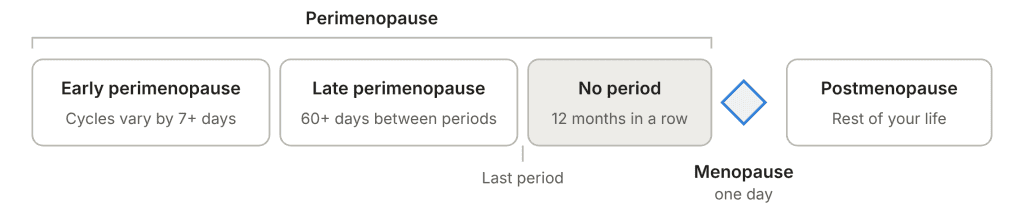
Perimenopause is 4-8 years of hormonal chaos then decline that runs right up to the menopause date, including the 12 months with no period. Everything after that day is postmenopause.
Find your stage
Start with your periods, then check your age. If you are not on hormonal birth control and still have your uterus, this is usually enough to find your stage.
- You still get periods, but they have changed. Cycles are shorter, longer, heavier, lighter or less predictable, and you may have hot flashes, night sweats, poor sleep or mood changes. You are likely in perimenopause. This usually starts around age 47.
- Your cycle length now swings by 7 days or more from month to month. This is typical of early perimenopause.
- You have gone 60 days or more without a period at least once. This is late perimenopause. Menopause is often 1 to 3 years away.
- You have gone 12 months in a row with no period. You have reached menopause. The average age in the US is 51.
- It has been more than 12 months since your last period. You are postmenopausal, and you stay in this stage for the rest of your life.
- You are under 40 and your periods have stopped “naturally” or become rare. This is not a normal stage. See a doctor to check for premature ovarian insufficiency (POI) or PCOS/PMOS (polycystic ovarian syndrome/polyendocrine metabolic ovarian syndrome).
Not sure? Track your periods and symptoms for 3 months. A simple log of your periods and symptoms is the most useful thing you can bring to a doctor’s visit.
What changes at each stage
| Perimenopause | Menopause | Postmenopause | |
|---|---|---|---|
| When | Usually starts in your late 40s and lasts 4-6 years, sometimes up to 10 | One day: 12 months after your last period | Every day after menopause |
| Periods | Irregular, heavier or lighter, skipped | Stopped for 12 months | None. Any bleeding needs a doctor’s visit to check for endometrial cancer, polyps, etc. |
| Common symptoms | Hot flashes, night sweats, poor sleep, mood swings, brain fog, heavy bleeding | Hot flashes and night sweats often peak around this time | Hot flashes fade over the years but can continue, peaking in frequency through 2 years postmenopause; vaginal dryness and painful sex often get worse |
| Can you get pregnant? | Yes. Keep using birth control | Pregnancy is very unlikely once the 12 months with no period are confirmed | No |
| What helps | Low-dose birth control, progestin IUD with estradiol added, HRT including vaginal estrogen, non-hormonal options | HRT including vaginal estrogen, non-hormonal options | HRT including vaginal estrogen, non-hormonal options |
Perimenopause is when your ovaries start to turn off. In early perimenopause, estrogen and progesterone rise and fall chaotically, which is why symptoms can come and go from month to month. This is often the hardest stage, and the one people and providers most often brush off as “just stress.” In late perimenopause, the ovaries have a steady decline in estrogen production.
Menopause is a single day, not a phase. Many people use the word to mean the whole transition, and that’s fine in conversation. Medically, it marks the day your ovaries have stopped releasing eggs for good.
Postmenopause is when your ovaries are done or making very little hormone. Hot flashes ease for many people, but low estrogen keeps affecting the vagina, bladder, bones, and heart. This is why treatment can still help and may be needed long after your last period.
When the 12-months-without-a-period rule doesn’t work
The 12-months-without-a-period rule only works if your periods are natural. If something else controls your bleeding, your symptoms and age become the main clues.
You’re on the pill, patch or ring. The bleed you get on placebo days is a withdrawal bleed, not a true period, and the hormones can treat perimenopause symptoms too. Many people stay on low-dose birth control through perimenopause because it controls both bleeding and symptoms. Around age 50 to 55, your doctor can help you decide when to stop or switch to HRT.
You have a hormonal IUD or implant. These often make periods very light or stop them, so you can’t count 12 months without a period reliably. Watch for hot flashes, night sweats, or cholesterol and waist circumference changes instead. A hormonal IUD can also serve as the progestin part of HRT later on.
You had a hysterectomy but kept your ovaries. You won’t have periods, but your ovaries still go through perimenopause on their own schedule. Your symptoms (hot flashes, night sweats, brain fog, genitourinary symptoms, LDL rises, etc.) can help tell you where you are.
Your ovaries were removed. This causes surgical menopause right away, often with sudden, strong symptoms. Talk to your doctor about HRT, especially if you are under 50.
You’re under 40. Periods that stop or become rare before 40 may be premature ovarian insufficiency (POI). Menopause between 40 and 45 is called early menopause. Both need a doctor’s care, because years of low estrogen raise the risk of bone loss and heart disease. Read more in our post on early menopause and POI.
Do you need a blood test to diagnose perimenopause and menopause?
Usually not. If you are over 42 and have perimenopause symptoms, your doctor can diagnose it from your periods and symptoms alone.
Hormone levels swing a lot during early perimenopause. Your FSH (follicle-stimulating hormone), estradiol, and progesterone levels can be high one week and normal the next, or vary from hour to hour, so one result can’t tell you your stage. Birth control also changes the results. We cover this in more detail in how to tell if you’re in perimenopause and hormone testing for menopause. The Menopause Society and the American College of Obstetricians and Gynecologists do not recommend blood testing for the diagnosis of peri/menopause because you can diagnose them based on age, periods, and symptoms. And the chaos of early perimenopause can give false normals.
A blood test can help in a few cases:
- You are under 40 to 45 and your periods have stopped or changed.
- Your doctor wants to rule out other causes, like thyroid problems or pregnancy.
- You are over 50 on progestin-only birth control and want to know when you can stop it.
How Pandia Health can help
You don’t have to wait for a year without periods to get help. Symptoms in any stage can be treated, and the right option depends on where you are: low-dose birth control or a progestin-only pill with add-back estradiol in perimenopause, HRT after menopause, and vaginal estrogen for dryness at any point.
Pandia Health’s menopause doctors work online, so you can get care from home. Fill out a short health questionnaire, a doctor will review your health history and symptoms, and Pandia Pharmacy can send your prescription to your mailbox.
This article is for general information and is not a substitute for medical advice.