

 Login
Login


 Back to Blog
Quick answer: Hot flashes and night sweats happen because shifting estrogen narrows the comfort zone of your brain’s internal thermostat, so tiny temperature changes trigger a full-body cool-down: flushing, sweating, sometimes a racing heart. They are extremely common, they are treatable, and you have options ranging from cooling strategies and trigger management to FDA-approved medications.
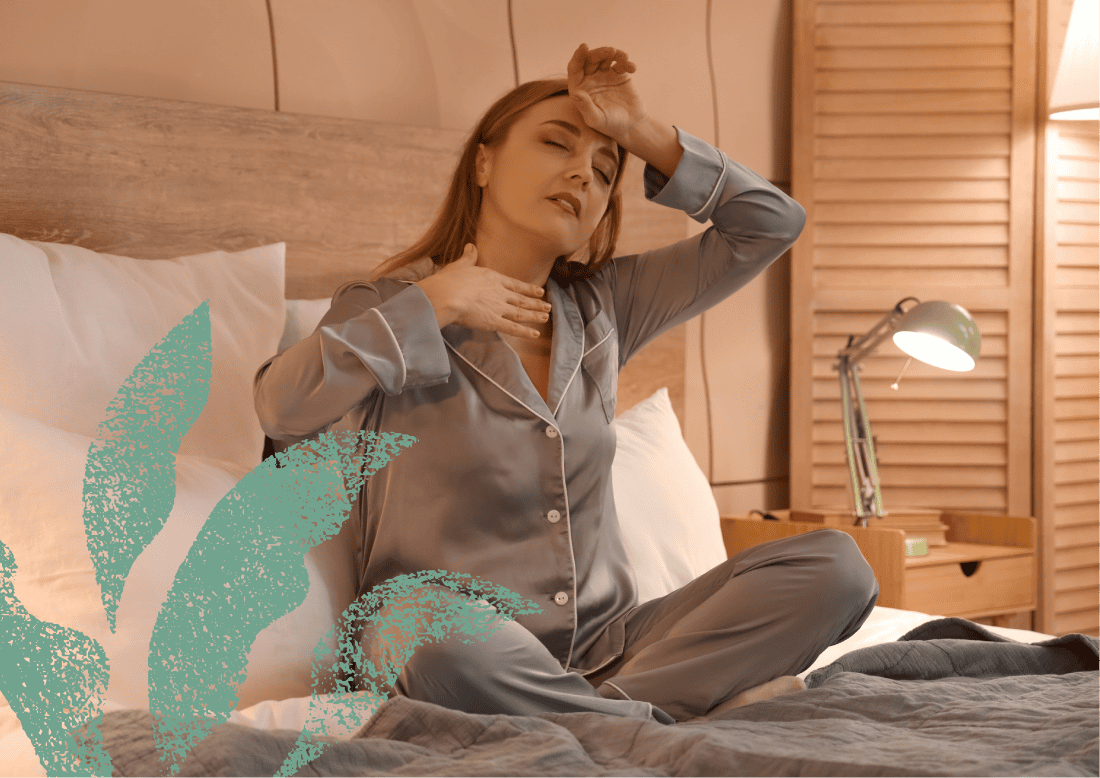
Let’s talk about the thing that wakes you up at 3 am with your pajamas stuck to you and your sheets drenched. You throw off the covers, then you’re freezing, then you’re wide awake staring at the ceiling. Or it hits you mid-meeting: a wave of heat crawling up your neck, your face going pink, sweat beading while you try to keep talking like nothing is happening.
You are not imagining it, you are not “just warm,” and you are absolutely not alone. Up to 80% of women get hot flashes and night sweats during the peri/menopause transition, according to The Menopause Society. Here is what is actually going on, and what genuinely helps.
Why do hot flashes happen?
Picture the thermostat on your wall. It has a comfort zone, a range where it does nothing, and it only kicks on the heat or the AC when the temperature drifts outside that range. Your brain has one too. It lives in a region called the hypothalamus, and its job is to keep your core temperature steady.
As you move through perimenopause and menopause, your estrogen levels start going up and down and dropping randomly. That hormonal change narrows your thermostat’s comfort zone dramatically. Suddenly, a temperature change so small you would never normally notice it registers as “way too hot.” Your brain panics and slams the emergency cool-down button.
That cool-down is the hot flash. Blood vessels near your skin dilate to dump heat, which is the flushing and the warmth. You sweat to cool the surface. Your heart may speed up. Then, once you have shed all that heat, you can swing the other way into chills. At night, this same sequence plays out in your sleep, and you wake up in drenched sheets. Same mechanism, different setting.
How long do hot flashes last?
Two answers, because there are two clocks running.
A single hot flash usually lasts one to five minutes. That is the wave: it builds, it peaks, it passes.
The bigger stretch is longer than most people expect. The Menopause Society reports that hot flashes and night sweats persist for an average of 7 to 10 years. For some women, they are brief. For others, they start in perimenopause, years before periods stop, and linger well past menopause. Knowing the arc matters, because it means these symptoms are worth treating, not just white-knuckling through it because they last so many years.
What triggers hot flashes?
Triggers are not the underlying cause, but they can tip a hyper -sensitive thermostat over the edge. Common ones include:
- Heat: warm rooms, hot showers, summer weather, a heavy blanket
- Alcohol, which dilates blood vessels and, per the Sleep Foundation, also fragments your sleep and activates the sympathetic nervous system that spikes heart rate
- Spicy or hot foods
- Caffeine
- Stress and anxiety
- Smoking, which is also a known risk factor for having hot flashes.
You do not have to give up everything on this list forever. The key is to notice your personal patterns. If a glass of red wine reliably heats you up at midnight, that is useful information, not a lifetime of abstinence.

What actually helps?
There are lifestyle changes and medical options. Both are legitimate. You do not have to earn medication by suffering through lifestyle changes first.
Cooling and everyday strategies
-
- Dress in layers you can peel off fast. Lightweight, breathable fabrics are your friend.
- Cool your sleep setup: lower the bedroom temperature, use a fan, try moisture-wicking sheets and sleepwear.
- Keep cold water nearby and sip it when a flash starts.
- Avoid your triggers by using what you learned above.
- Rethink alcohol, especially in the evening. The Sleep Foundation notes that even though a drink feels sedating, it worsens sleep quality and can make night sweats and 3 am wake-ups worse.
- Eat in a way that supports you. A Mediterranean-style pattern, rich in vegetables, fruits, whole grains, olive oil, nuts, and fish, keeps your blood sugar stable, which can prevent sudden hormone changes. If you lose weight, then your body is cooler as per the Cleveland Clinic.
Medical options
When hot flashes and night sweats are moderate to severe, disrupting your sleep, your work, or your sanity, medication can be genuinely life-changing.
-
-
- Hormone therapy (HT or HRT) is FDA-approved and considered the most effective treatment for hot flashes and night sweats, beating any supplement or lifestyle options. HT comes as pills, patches, sprays, gels, and rings. Whether it is right for you depends on your health history, so see a doctor, ideally a menopause trained/experienced one. Learn more about hormone therapy options.
- FDA-approved non-hormonal medications exist too, which is great news if hormones are not an option for you. Low-dose paroxetine (Brisdelle) is FDA-approved for hot flashes. Fezolinetant (Veozah), a neurokinin-3 receptor antagonist approved in 2023 and elinzanetant (Lynkuet) target the brain pathway involved in that thermostat misfire and elinzanetant also helps with sleep. However they are expensive = ~$500-$750/month.
-
The right path is personal. A doctor who has menopause experience/expertise can match you to the best option for your body and your history.
You do not have to just “ride this out”
Hot flashes and night sweats are common, but common does not mean you are stuck with them. Understanding why they happen is the first step and having options are the next steps.
Pandia Health’s expert peri/menopause care is asynchronous and 100% doctor-provided care. Our doctor team provides care where you are, prescriptions ship free to your door, and you can consult with a doctor when you have questions. If those drenched sheets are wearing you down, let’s get you help.